Friday, 14 October 2011

A price fair and true


Several teachers have mentioned to me that teaching Timorese can be challenging because they are not well-versed in the habit of critical thinking . . . (Can I cynically suggest that they are ahead of the times since clearly Western countries are valiantly attempting to educate their citizens in the more politically preferable art of NOT thinking?) 
This is certainly true with regard to the traffic.  When my students find out I ride a motorcycle they all warn me, “Be careful.  The traffic here is crazy!  There are many accidents every day.”  Despite this belief no one, it seems, has thought that it might become less crazy if people, well drove more sensibly.  It’s simple cause and effect.
Anyway, my housemate Gabe told the story of a chicken who met an untimely demise at the hands – or more precisely, wheels – of a wheel driving through the residential streets.  This is nothing new.  Animals wander freely and so it is inevitably that they will be hit by cars and motorcycles.  It is also nothing special for the driver to offer monetary compensation of ten to twenty dollars to the animal’s owner.  While the dogs might not be primary producers, the goats and chickens and roosters might be a major breadwinner in the household.  And there in lies the story of the ten thousand dollar chicken (and that’s US dollars, which makes the story greater or lesser, depending on the exchange rate).
So the bones of the story are this:  Chicken runs into road.  Car drives down road.  Driver fails to see chicken.  Chicken meets wheels.  End of chicken.  But the commencement of the interesting part of the story.
So the driver gets out and offers to pay compensation.
“How much?” he asks the chicken’s owner.  “What’s a fair price?”
The owner pauses, frowns a moment and then says, “Ten thousand dollars.”
“Ten thousand dollars!” the driver splutters.  “What the . . . ?”  (okay I embellish).  “I’m not paying ten thousand dollars.  How is that a fair price?”
“Well,” says the chicken’s owner.  “That wasn’t an ordinary chicken. That was a prized egg-laying chicken.  She produces at least five eggs a day, every day.  She was a fairly young chicken and so had many egg-laying years ahead of her.  Then I’ve had to add in her children.  She was the best layer I’ve ever had.  I was planning on breeding her and then I would also have those hens that would also be good layers and then their daughters too.  Imagine it!  A whole line of exceptional egg-layers.” 
Here the chicken’s owner might have glanced sadly at the pile of feathers and bones. “But of course,” he might have added, “that will now not happen.”
He might have looked back at the driver and continued, “You seem like a reasonable man, a business man even.  I’m sure that you can see my predicament and that given the circumstances, ten thousand dollars for my best egg-layer and all she is now unable to accomplish is more than fair.”

PS.  The outcome of this exchange is unknown and would probably ruin a good story ;-)

Culture shock


Someone recently mentioned that the thought I was experiencing culture shock.  It was an assumption on their part supposedly based on the fact that I had complained about the heat, and the traffic.  I dislike the way we humans always clutch at negatives, hopeful perhaps that someone else is as miserable as we are.  It’s macabre and apparently spliced into our DNA.  That aside, it led me to consider the term “culture shock”. 
Is it culture shock to complain about the heat?  Hmmm, to begin with, man’s involvement with climate change aside, the heat is presumably a natural phenomena and so separate from culture.  Sure weather can impact the habits and traditions people adopt and therefore influence their cultural pursuits but it isn’t a component of culture per se.
So what is culture?  It might seem a trite question, but when you analyse it, particularly in terms of a developing country you begin to realise that the ‘culture’ to which we might be referring  to in the expression “culture shock” has nothing to do with the locals and everything to do with what we left at home.  We are not shocked so much by local culture, we are horrified that there isn’t more of our own – or that the ‘culture’ which apparently ‘shocks’ us is a dysfunctional hybrid of local resources and western expectations.  Why can’t we have the comforts of home exactly as we like them? 
Sorry, I personally didn’t come here to experience home.  That would have been nuts – and quite expensive too.  Hell, I could have saved the airfares and the cost of vaccinations and just stayed in Melbourne.  To people that travel overseas expecting what they are used to and comfortable with, I have two words:  “Stay home!”
Besides, the true culture of Timor has nothing to do with Dili and the way it works – or doesn’t work.  Timor’s true culture lies in the districts where the emphasis is on relationships, on family, on everyone having enough to survive, but not striving to amass considerably more for no other reason than to have acquired more than someone else.  It isn’t Dili Beach Hotel or One More Bar, the distinctly Australian establishments that cater to Aussie sporting tastes.  I can’t imagine, either that phone cards or taxis feature greatly in Timorese folklore.  Not sure about the UN vehicles either.  Even the older buildings are more Portuguese than Timorese. 
So anyone coming to Dili might indeed experience a shock.  They might expect Timorese culture and instead be faced with a mishmash of imports from around the globe, brought here, not to truly enhance what already existed, but rather to impose outside standards, expectations and requirements with scant concern for the culture over which these are being superimposed.
And for that reason the person suggesting I am experiencing culture shock is spot on – but for the wrong reasons.  Culture shock for me isn’t about the weather or the traffic or bureaucratic red tape.  Geez, as if I haven’t complained about those ad nauseum in Australia. 
No, culture shock for me is the new Timor Plaza.  Yes.  Precisely what the locals need – a western style shopping centre apparently decked out with Australian stores selling furniture, homewares, sporting goods and groceries.  I am assured that the wealthy Timorese, if not the everyday mums and dads, will be able to shop there.  Perhaps it will employ some people – we can only hope this is on more than a subsistence wage. 
To me Timor Plaza is a monstrosity, a shocking example of how we ‘develop’ countries not by supporting what already existing, not by providing things everyone in the world has a right to – food, education, a roof over their head, the ability to support themselves and their families in their traditional ways.  No.  Clearly no country can consider itself ‘developed’ until it has a shopping centre.  And to add insult to injury it is, in classic western fashion, right next door to an existing retailer that sells food and homewares. 
That’s the shocking thing about Timorese culture – how much of it has already and will continue to disappear under the auspices of ‘development’ and ‘progress’.

Present perfect


The Timorese will tell you that Timor is not like Australia; Australia has money.  The US has money.  England has money.  Everywhere else is rich by comparison, at least to Timorese eyes wearied by the heat, the dust, the sight of the unemployed, or the underemployed, the dysfunctional sewerage system, the roads that in places are more off-track adventures than expeditious thorough-fares.  And yet . . . and yet . . .
There are many reasons why Malae come to Timor-leste.  Having come, many outstay their initial plans.  Why?  Why indeed when Australia is so rich, the lifestyle so much easier, the electricity infinitely more reliable, the traffic more ordered?  The list might be lengthy for someone with a mind to itemise the challenges of living in Dili.  But Malae come and Malae stay. 
I can’t speak for other Malae, only for myself and for me I am almost in tears every day.  Not tears of frustration or deprivation or longing to be somewhere else.  No, my emotions are evoked by how the simplest of things, the things we so blithely take for granted mean so much.  Here I am rich, not just in money, but in world experience and most importantly English.  I have something that is so easy for me to give that in Australia it would be almost disregarded but here, I am sadly almost a Goddess.
People ask, “What do you do?”  and the words, “I teach English” incite a reverent, “Oh you teach English.”  It is embarrassing.  It is humbling.  And I feel privileged to be able to share my language with these ever-eager students.
Last Friday, after my last class of what was a long (and largely electricity-bereft) week, one of my students came up to me and said, “Today I am so happy.” 
“Why are you happy?” I asked, thinking his reply, in his mind at least, might be, “It’s Friday and me and my mates are goin’ out on the piss.” Or “Wallabies play the Springboks this weekend.  It’s gonna be awesome.” Or “I sent my girlfriend flowers.  I’m pretty sure she’ll put out tonight.”  Well, you get the idea. 
He said, instead, “I am happy because I have learnt this.  I need to learn how to speak in English and you have taught me this.”  He gestured towards the board where notes about the present perfect and past simple still graced the portable white board.  “Thank you,” he added.
I smiled.  “You’re very welcome,” I said.  But what I was thinking was. “Oh my god, can I give you a hug?  What a precious gift you have given me.”  Who’d have ever thought that anyone anywhere would revel in learning the present perfect?  (And be honest – how many of you don’t even know what the present perfect is?  I do now, but I never used to.)
Again today, my student worked very hard.  He is the gardener for Conaco Phillips, a mining company.  They pay for one-on-one English lessons which he relays to his eight-year-old son.  My student worked very hard today.  There was lots to remember – we worked on the rules of making plurals.  Yeah, something you probably don’t think twice about.  He has to think twice, three times, four times, five times, sometimes even six or seven times.  It isn’t easy.  Sometimes I find my patience waning.  I remind myself that he is here.  It is difficult.  It is difficult and yet he comes – on time, every Friday afternoon.  At the end of the lesson I said to him, “You worked really hard today.  That was very good.  I’m impressed.” He said, “I have good teacher.”
And last night . . . well last night I probably broke the rule of not giving English lessons outside of my clients.  It’s a reasonable rule.  Basically our school doesn’t want its teachers poaching its clients.  It has become impossible for me not to in this one situation – ANZ.  As I’ve mentioned before there is a security guard outside and one inside.  Basically the one inside sits just outside the circle of my students.  He can hear every word, yet can’t participate.  Fair enough.  He’s there to guard the bank.  But it’s after hours and the only people inside the bank are staff, contract cleaners, a security guard and an English teacher.  I can’t speak for myself, but the others certainly can’t be considered shady characters.
Last night the guard was young.  He was paying attention and so, as I was giving out the exercise sheets, I slipped behind my students and offered him one.  He took it.  He filled it in.  I gave him one of everything we did, even the homework.
As I was leaving, he came up to me outside.  He wanted to clarify some of the answers to the homework questions.  He got them right.  I wanted to hug him; to thank him for listening, for wanting to learn, for allowing me the privilege of perhaps expanding his job opportunities and maybe in moments when I let my daydreams turn fanciful, even enhancing his life in ways I could never imagine.
The Malae come to Timor-leste for various reasons but they stay because Timor-leste offers them something Australia seems to have lost the ability to provide – a sense of contribution; that feeling that what you do each and every day matters.  Here, in Asia’s poorest country, the simplest of things truly do matter and the gratitude of the wonderful Timorese is a priceless gift and certainly a drug that many Malae are happy to trade  for reliable electricity, good roads and a functional waste disposal system.  It’s an unfair trade.  We get so much more than we sacrifice.

Saturday, 8 October 2011

We have piles . . . and then we don't!

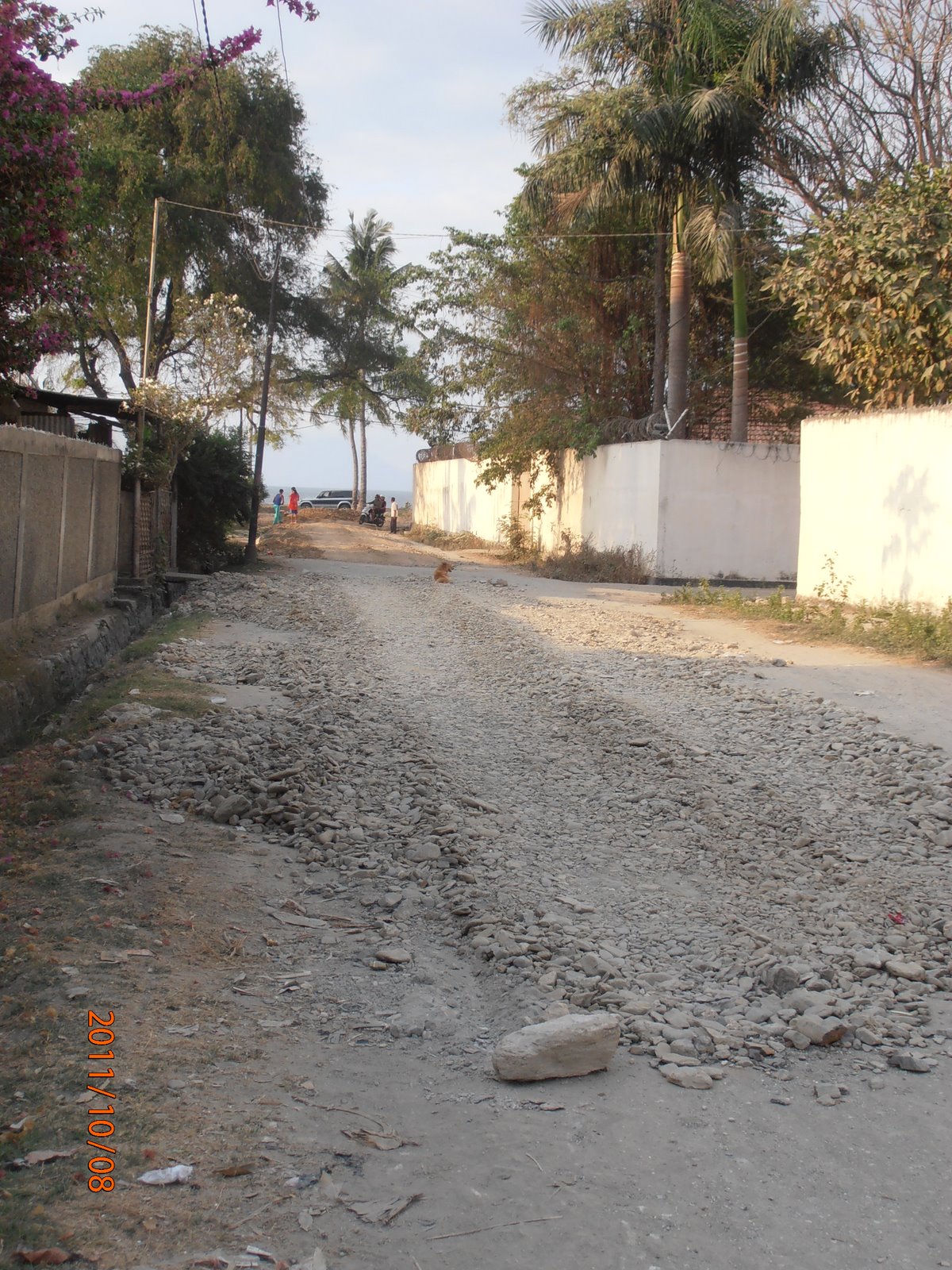
The landscape of the Beach Rd. end of our street is a changing landscape.  Literally.  One day, it was clean walking, riding, driving to the end.  The next we were thwarted by piles of rocks and gravel.  There is speculation that perhaps these piles appeared as a result of construction work - a block of apartments is being built on the block beside them.  There was also the suggestion that they had been dumped there to build up the road, with the expectation that road users would gradually spread them across the surface.  And this is exactly what has happened.


On the street where I live

This is the street where I live.  If you squint and look very closely you'll see a blue gate in the distance and to the left.  This is my house.

Duck!


This duck, the only duck I have seen in Timor was enjoying a bath in a pot hole in our street. It is not yet the wet season and it hasn't rained since I've been here. The water is from people bucketing it from a channel that runs down the side of the road. They throw it into the road to dampen down the dust . . . and apparently create bird baths :-)

Dili Beach Hotel

This is Dili Beach Hotel where I go for coffee, coke, Solo and "free" Wifi. I have been here so often now, I am on a first-name basis with two of the waitresses - and they know how I like my omelette :-)